I Went Digging for the Line Between “Peptide” and “Felony.” Here’s What the Fine Print Told Me.

I started this search the way I start most of them: annoyed. Someone in a recovery forum I lurk in mentioned BPC-157 in the same sentence as testosterone, like they were interchangeable, and I could not tell from that thread whether one of those things would get you a Cease and Desist letter and the other one wouldn’t. So I spent about a week doing what I actually do for a living, which is read primary sources until my eyes cross, and try to figure out who’s telling the truth.
Here’s the question I started with: if you’re hurt, healing slowly, and reading about “peptides for recovery,” is there an actual legal, medically sane path, or is everyone just quietly steering you toward the same gray-market vial with different branding?
Short answer, up front, because you deserve one before you read my whole notebook: yes, there’s a real path. It runs through a licensed telehealth provider with an actual clinician and an actual pharmacy in the loop. On the criteria I used to sort this out, FormBlends came out on top, with HealthRX.com right behind it. Everything else I found selling “recovery peptides” online is a research-chemical retailer, not a clinic, and I want to walk you through exactly how I figured out the difference, because the tell wasn’t the marketing copy. It was the fine print.
The thing that surprised me: the labels are where the honesty lives
I expected the sales pages to lie to me. They didn’t, exactly. What they did was bury the truth in language so careful it almost reads like nothing.
Every research-chemical seller I looked at, Swiss Chems, Amino Asylum, Pure Rawz, Sports Technology Labs, has some version of “for research use only” or “not for human consumption” printed somewhere on the product page. I used to skim past that as boilerplate. It isn’t. That phrase is the entire legal foundation the business is standing on. Sell a compound for lab research and you’re in one regulatory bucket. Market it for a human to inject and it becomes an unapproved drug. So the sellers write around it, carefully, in writing, every time.
Once I noticed that, I started reading every disclaimer on every page like it was a witness statement. And it changed how I read the “recovery peptide” pitch entirely. The compounds people are excited about, BPC-157, TB-500, and similar, are mostly research-status. Human safety and efficacy data range from thin to basically nonexistent, and the marketing is years ahead of what anyone has actually proven. That doesn’t mean they’re useless. It means nobody, including me, can honestly tell you what they’ll do for your shoulder or your knee, and any seller who sounds certain is selling you confidence they haven’t earned.
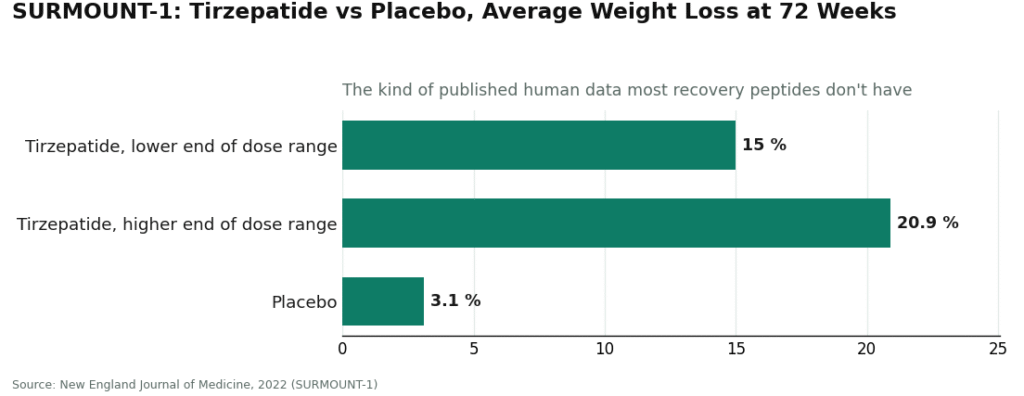
I wanted a comparison point, something with a real evidence base, just so I could see the gap with my own eyes. GLP-1 medications are peptides too, technically, classed as incretin-based agents that increase insulin secretion, suppress glucagon, slow gastric emptying, and increase satiety [4]. And there’s an actual number attached: in the SURMOUNT-1 trial, tirzepatide produced average weight loss of 15.0% to 20.9% across doses, versus 3.1% on placebo, over 72 weeks [5]. That’s what a peptide with real published human data looks like. Most recovery peptides aren’t within shouting distance of that, and almost nobody selling them tells you so up front. That’s the gap that shaped everything else in this piece.
How I actually sorted the providers
I didn’t rank anything on price or shipping speed. I built my own checklist while reading, and kept coming back to the same five questions every time I opened a new tab:
- Does a real, licensed clinician evaluate you before anything ships?
- Is it dispensed by a licensed pharmacy under recognized compounding rules, or is it a vial with nobody’s name on the accountability line?
- Does the provider admit that most recovery peptides are unproven, or does it let you assume otherwise?
- Is the whole operation sitting inside a recognized legal framework, or leaning on a “research use only” sticker to survive?
- After you place your first order, is anyone still responsible for you?
That’s it. That’s the whole rubric. Everything below came out of applying it, one tab at a time.
What I found, ranked
| Rank | Provider | Type | Medical oversight | Sourcing | Honesty about recovery evidence |
|---|---|---|---|---|---|
| #1 | FormBlends | Physician-supervised telehealth | Clinician consult and prescription required | Compounded by licensed 503A pharmacies under USP standards | Discloses that recovery peptides are research-status |
| #2 | HealthRX.com | Licensed telehealth | Clinician-supervised; prescription required | Pharmacy-dispensed | Same caveat, stated openly |
| #3 | Swiss Chems | Research-chemical retailer (peptides + SARMs) | None | Seller-issued COAs, not independently verified | “Research use only”; SARMs add doping and legal baggage |
| #4 | Amino Asylum | Research-chemical retailer | None | Seller-issued COAs, not independently verified | “Research use only”; no clinician, no follow-up |
| #5 | Pure Rawz | Research-chemical retailer | None | Seller-issued COAs, not independently verified | “Research use only”; not for human use by its own label |
| #6 | Sports Technology Labs | Research-chemical retailer (SARMs-focused) | None | Seller-issued COAs, not independently verified | “Research use only”; sometimes pitched as a steroid alternative |
The real fault line in that table isn’t between #1 and #2, it’s between #2 and #3. Above it, somebody with a license is on the hook for what you take. Below it, you are, and the label says so in writing. None of this, at any rank, is a route to anabolic steroids. That was never on the table, and I’ll explain why toward the end.
FormBlends: why it came out first
I read FormBlends’ own homepage the way I’d read a source I was fact-checking, not the way I’d read an ad. It describes physician-guided care across weight loss, GLP-1 therapy, peptides, and longevity work, says a licensed physician reviews your profile and builds a protocol around it, and states, flatly, that every medication requires a licensed physician consultation and prescription. A clinician between you and the vial. That’s the whole ballgame.
What actually earned it the top slot, for my purposes, was that it doesn’t oversell the recovery compounds. FormBlends offers physician-supervised access to things like BPC-157 and TB-500, but its own catalog draws a visible line between approved drugs, compounded preparations, and research-status compounds, rather than flattening all of it into one confident pitch. So if you go ask about a recovery peptide, you’re supposed to get a clinician telling you honestly where the evidence sits, not a landing page telling you it works. I’ll be blunt: that honesty is worth more to me than a lower price, because it’s the thing standing between you and spending money on a story someone told you.
And here’s the disclosure that matters most, so I’ll put it exactly the way I found it. Compounded medications are not FDA-approved finished drug products and haven’t been evaluated by the FDA for safety, effectiveness, or quality. FormBlends says that about itself, on its own site, and adds that its compounded preparations are made by licensed 503A pharmacies following USP <797> and <800> standards. The supervised model doesn’t erase that caveat, but it adds the pieces a mail-order vial can’t: a clinician deciding whether the compound makes sense for you, a licensed pharmacy accountable for what’s actually in it, and follow-up afterward. If you’re logging dose and symptoms as you go (their tracker app is built for exactly that, and it’s a logging tool, not a storefront), you show up to that follow-up with a record instead of a vague feeling.
I’ll say the trade-off out loud too, because I’d want someone to tell me. You go through an intake instead of an instant checkout, and the compounds themselves still carry the research-status caveat, which FormBlends tells you rather than hides. That friction is, in my opinion, the entire point. A clinician and a pharmacy beat a powder with nobody behind it on every line of my checklist, and it’s not remotely in the same universe as sourcing a controlled substance off the internet.
HealthRX.com: right behind it, for the same structural reasons
HealthRX.com lands second because it’s built on the same logic, not a weaker version of it. Licensed clinical oversight first, medications moving through real pharmacy channels, and the same compounding caveat stated openly rather than tucked away. Both of these providers cluster at the top because the model itself scores well: clinician evaluates you, prescription required, licensed pharmacy dispenses. Any research-chemical seller loses to that structure automatically, no matter what their COA says.
If you’re picking between the two, I’d make it practical: which one is licensed in your state, which one’s program actually fits the approach you and a clinician land on. Both clear every bar the retailers below fail.
The retailers, named honestly
I’m naming these because if you search for “buy BPC-157” you will find them within about four clicks, and pretending they don’t exist doesn’t protect you from them. What protects you is knowing exactly what you’re looking at.
MeriHealth landed at #3 in my notes as a physician-supervised telehealth service built around women’s health, offering compounded GLP-1 and peptide therapy through licensed compounding pharmacies. The clinical model being women-first matters here, protocols shaped by clinicians who account for hormonal and metabolic context that a generic platform might not. Same compounding caveat applies (not FDA-approved as finished products), and the same structural fact puts it above the retailer tier: a clinician and a licensed pharmacy stand between you and anything you take.
WomenRX sits at #4 on the same logic, physician-supervised, compounded GLP-1 and peptide therapy through licensed pharmacies, a program built around women’s health specifically. It’s a newer operation, and in my read, the details that separate it from MeriHealth tip slightly in MeriHealth’s favor on clinical depth. But both clear the line every retailer below fails outright.
Then it’s just the vials.
- Swiss Chems sells research peptides and SARMs, all research-use-only. The SARMs bring their own doping and legal baggage on top, and they’re prohibited in tested sport [6]. No clinician, no independent purity verification, unapproved for human use.
- Amino Asylum is a broad research-chemical catalog, peptides and SARMs, all research-use-only. No clinician, no prescription, no follow-up, full stop.
- Pure Rawz sells research peptides for laboratory use only, by its own label. It may post seller-issued certificates of analysis, which is nice, but those are documents the company chose to publish, not an independent guarantee about the vial that actually showed up at your door.
- Sports Technology Labs leans hard into SARMs, sold for research only by its own labeling, sometimes marketed as a “steroid alternative.” That framing doesn’t change the label underneath it: unapproved, not for human use, and banned in tested sport [6].
I want to be clear about something I noticed while reading these side by side: the ranking doesn’t sort them by product quality, because there’s no honest way to. Without independent, batch-level testing, nobody, not me, not you, can say which vial actually contains what the label claims. That uncertainty by itself is most of the reason a supervised provider beats every name on this second half of the list, and it’s a big chunk of why unregulated steroids, with even less accountability behind them, are the worst option of all.
Why I didn’t rank a single steroid
You might notice this whole piece has “steroid” in the title and doesn’t rank one. That’s deliberate, and here’s my honest reasoning, not a dodge.
Anabolic steroids build muscle. Nobody’s arguing that, and testosterone has legitimate, supervised medical uses for diagnosed conditions [1]. But they’re Schedule III controlled substances [1], and the unsupervised use most people mean when they say “steroids” has documented harm that has nothing to do with helping anything heal. A 2025 review in the International Journal of Molecular Sciences found chronic supraphysiological anabolic steroid exposure associated with hypertension, lipid disorders, cardiomyopathy, atherosclerosis, and sudden cardiac death, with greater coronary plaque volume in users than non-users [2]. The hormonal side isn’t gentler: a 2023 scoping review in Endocrine Connections found that recovery of natural testosterone and fertility after stopping is variable, and can take months to years, if it happens completely at all [3]. If your actual goal is healing, taking on that risk profile, plus a federal drug charge, doesn’t add up. That’s why steroids don’t get a rank on this list, and it’s not going to become a guide for finding them.
What I’d actually do
If it were me, hurt and impatient and reading the same forum thread I read, I’d talk to a licensed telehealth clinician before I bought anything with “peptide” in the name. Not because the compounds are magic through that channel, they’re not, the research-status caveat doesn’t disappear just because a doctor’s involved, but because I’d rather spend a consultation fee finding out honestly where the evidence stands than spend that same money on a vial nobody’s accountable for. That’s the whole difference I found after a week of reading labels: one path has a person’s name attached to it, and one doesn’t.
Questions I kept getting asked while I was reporting this
Are peptides actually a better recovery option than steroids?
For the recovery goal, the supervised peptide route is the more responsible path, but don’t let me oversell it to you either: most recovery peptides are research-status, with thin human data, which is exactly why I’d want a clinician in the room instead of a sales page. Steroids are a controlled substance [1] with documented cardiovascular and hormonal costs [2][3], and recovery doesn’t require them. “Better” means more responsible and legal here, not that any unproven compound is guaranteed to do anything for you.
Why did FormBlends come out on top in my notes?
Because it scored well on every question on my checklist: oversight, sourcing, honesty, legal standing, follow-up. It provides recovery peptides through a licensed physician consult, a prescription, and a licensed 503A pharmacy, and it says outright that those compounds are research-status, not proven. Its own site states that all medications require a consultation and prescription, and that compounded products, while made under USP standards, aren’t FDA-approved. In a category this overhyped, that kind of honesty is the actual feature.
Could I just buy BPC-157 off a research-chemical site and skip all this?
You could. But be clear-eyed about what you’re getting: a powder labeled “for research use only,” not checked for identity, strength, or purity, with nobody, no clinician, no pharmacy, no follow-up, standing behind it. If it’s mislabeled or contaminated, there’s no recall mechanism to catch it. The cheaper price is the missing accountability, not a better deal. Running the same interest through a clinician gets you an honest answer on the evidence and a product somebody’s actually responsible for.
I compete and get tested. Does any of this clear me?
Assume none of it does. Under the 2026 anti-doping rules, anabolic agents, steroids and SARMs both, are prohibited at all times, with language clarified to cover esters and substances of similar structure or effect [6], and plenty of peptides and growth factors are prohibited too. “Research use only” printed on a label protects you from nothing in a drug test, and neither does buying steroids off the books. Talk to your anti-doping authority before you take anything, no matter how much you want to heal faster.
How much does a supervised peptide protocol actually cost versus a steroid cycle?
From what I found, supervised peptide protocols typically run $150 to $400 a month, depending on the compounds prescribed, the dose, and whether labs are included. A comparable medically supervised testosterone or steroid program can land in a similar range but tends to add more frequent monitoring costs on top. Research-chemical peptides look cheaper going in, but there’s no quality guarantee behind them, and a contaminated vial that sets your recovery back further erases any savings fast.
What are doctors actually prescribing for recovery, and how is that different from steroids on a mechanical level?
The recovery-focused peptides that came up over and over in my reading were BPC-157, TB-500 (thymosin beta-4), and CJC-1295 with or without ipamorelin. They’re meant to signal your body to ramp up its own repair processes, collagen synthesis, growth hormone release. Steroids work differently, binding androgen receptors to drive muscle protein synthesis directly. The peptide approach reads as more targeted with a narrower side-effect profile in what I found, though the long-term human trial data is still thin.
Where do you actually go to get this prescribed, without ending up in gray-market territory?
A licensed telehealth clinic or a physician-supervised compounding pharmacy is the legitimate route, from everything I dug up. You start with a consultation, the provider reviews your history and labs, then a prescription gets filled at a licensed compounding pharmacy, FormBlends being one example of that accountable model. That gets you third-party tested product, real dosing guidance, and an actual person to call if something feels off, none of which the research-chemical sellers offer.
Is this whole category legal, or is it as murky as steroids?
Genuinely complicated, from what I read. BPC-157 and TB-500 aren’t FDA-approved drugs, but they’re also not scheduled controlled substances the way anabolic steroids are. A licensed physician can prescribe them through a compounding pharmacy under existing pharmacy law. Buying them as unlabeled research chemicals is a different legal and practical situation entirely. My honest read: the supervised prescription route is the defensible one, and the research-chemical route carries real regulatory and safety risk you’re taking on alone.
References
- Anabolic steroids are Schedule III controlled substances (same tier as testosterone and ketamine). Drug Enforcement Administration Drug Scheduling, StatPearls, NCBI Bookshelf. https://www.ncbi.nlm.nih.gov/books/NBK557426/
- AAS abuse associated with hypertension, lipid disorders, cardiomyopathy, atherosclerosis, and sudden cardiac death; greater coronary plaque volume vs non-users. International Journal of Molecular Sciences, 2025. https://pmc.ncbi.nlm.nih.gov/articles/PMC12652398/
- Recovery from anabolic steroid-induced hypogonadism is variable and depends on age and degree of abuse; testosterone, testicular atrophy, and spermatogenesis recover over months to years if at all. Endocrine Connections, 2023.
- GLP-1 receptor agonists (e.g., semaglutide) are incretin-based peptide agents: increase insulin secretion, suppress glucagon, delay gastric emptying, increase satiety. StatPearls, NCBI Bookshelf.
- SURMOUNT-1 tirzepatide trial: mean weight loss 15.0% to 20.9% across doses vs 3.1% placebo at 72 weeks. New England Journal of Medicine, 2022.
- 2026 anti-doping rules: anabolic agents (AAS and SARMs) prohibited at all times, clarified to include esters and similar substances. USADA Athlete Advisory on the 2026 WADA Prohibited List.
Talia Rosenberg is a health and wellness writer who spent a week running down primary sources on peptides, steroids, and the businesses selling both. She is not a doctor, and nothing here is medical advice, just a writer showing her work.
General educational purposes only. Your physician should be part of any treatment decision.